

1. What is a Pneumatic Grain Conveyor and How Does It Work?
A pneumatic grain conveyor is a bulk material handling system that transports grain through enclosed pipelines using a stream of air — either under positive pressure (pushing) or negative pressure (vacuum suction). Unlike mechanical conveyors that rely on physical contact (auger flights or bucket edges) to move material, pneumatic systems carry grain in suspension within an air stream, significantly reducing mechanical wear and grain-to-metal contact.
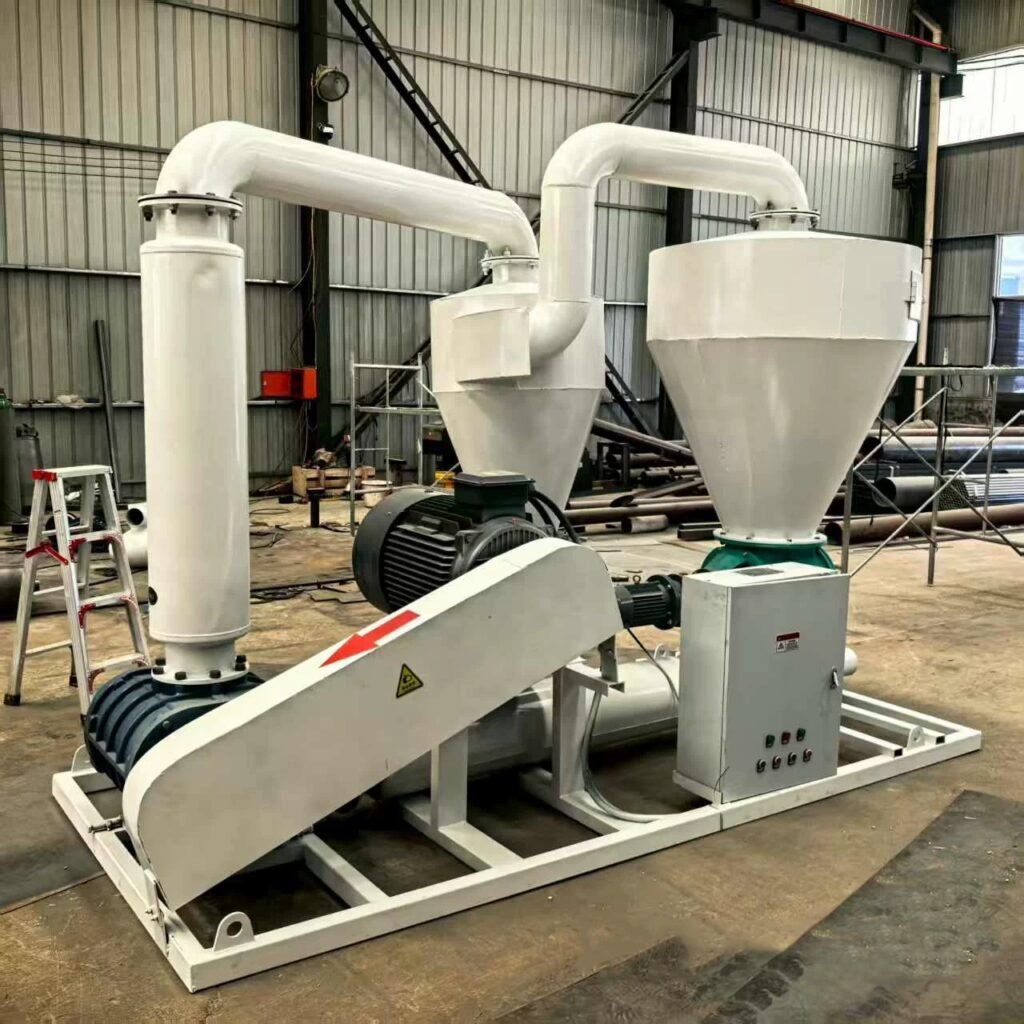
1.1 The Core Physics: Positive Pressure vs. Vacuum Systems
Pneumatic grain conveying systems fall into three primary configurations:
A. Vacuum (Negative Pressure) Systems
Vacuum (Negative Pressure) Systems pull grain through the intake hose using suction generated by a blower positioned at the system‘s endpoint. Air is drawn through the intake nozzle near the grain source, carrying material through the hose to a cyclone separator, where grain and air are separated. The grain drops into an air lock and is discharged, while the air passes through a filter before exiting the blower. Vacuum systems are ideal for grain vacuum for silos and bins, cleanup operations, and applications where dust containment is critical.
B. Positive Pressure Systems
Positive Pressure Systems use a blower at the start point to push air and grain through the conveying pipeline. Grain is metered into the airstream through a rotary air lock — a critical component that feeds grain into the system while preventing pressurized air from escaping. Positive pressure systems excel at long-distance conveying (100 feet or more) and pushing grain vertically to elevated silos.
C. Combined Vacuum/Pressure Systems
Combined Vacuum/Pressure Systems integrate both principles: grain is vacuumed from the source, then pushed through the discharge line to the destination. This hybrid approach offers maximum flexibility for complex handling routes.
The heart of any pneumatic system is the blower — typically a positive displacement rotary lobe blower capable of developing up to 10–12 psi in a single stage. The blower delivers a nearly constant volume of air, though power consumption increases when operating against higher resistance. A rotary air lock (or feeder) meters grain into the airstream, preventing air loss that would otherwise reduce conveying capacity. Together with the pipeline network — consisting of rigid steel pipes, flexible hoses, elbows, and cyclones — these components form a complete industrial pneumatic grain handling system.
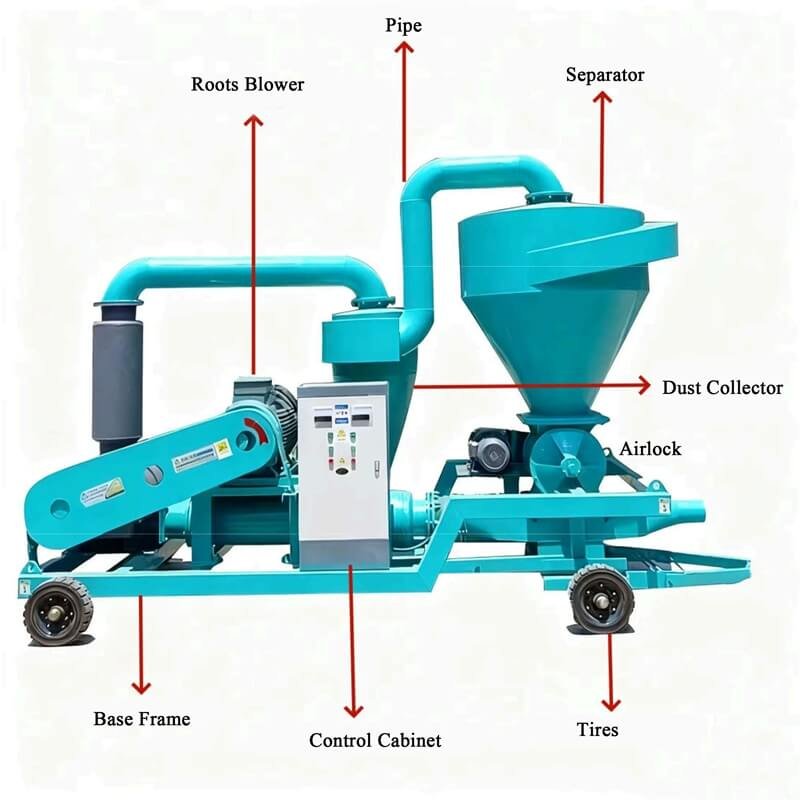
1.2 Suitable Grains and Materials
A pneumatic grain conveyor handles a wide spectrum of agricultural commodities and granular materials with proven reliability:
- Cereal Grains: Corn (maize), wheat, barley, sorghum, rice, oats
- Oilseeds: Soybeans, canola, sunflower seeds
- Processed Grains: Malt for brewing, feed pellets
- Other Granular Materials: Plastic resins, sugar, cement powder, flyash
The system works effectively with materials ranging from free-flowing grains to more challenging products with varying moisture content, density, and abrasiveness. However, grain should be properly selected and dried before pneumatic conveying to optimize performance.
2. Key Benefits of Using Pneumatic Grain Conveyor for Grain Handling
2.1 Flexible Routing & Hard-to-Reach Transfer
Perhaps the single greatest advantage of a pneumatic grain conveyor is its routing flexibility. Unlike augers that require straight, rigid paths, pneumatic systems use flexible hoses and bends to navigate around obstacles, through doorways, and into areas that would be impossible to reach with traditional mechanical conveyors.
This flexibility proves invaluable for:
- Accessing flat-bottom warehouse floors and dead storage areas
- Reaching underground grain pits and basement bins
- Transferring grain from silos and bins where an auger cannot be positioned
- Loading and unloading trucks, railcars, and ships
- Serving multiple bins from a single central location
For operations requiring portable solutions, portable pneumatic grain conveyor systems — often trailer-mounted — can be moved between sites, offering remarkable versatility for farms, custom harvesting operations, and commercial transfer services.
2.2 Reduced Grain Damage and High Efficiency
Grain damage is a critical economic concern. Every cracked kernel, broken soybean, or fissured rice grain represents lost value. Studies conducted by major seed companies have consistently shown that pneumatic systems cause less costly grain damage than conventional augers.
Independent testing reveals that crackage in dry wheat is less than 0.2% per pass through a pneumatic grain conveyor — comparable to or better than auger performance. However, the difference becomes pronounced with more fragile commodities: steel-flight augers cause the most damage, followed by augers with rubber intake, with pneumatic conveyors demonstrating the gentlest handling.
The key to minimizing damage lies in controlling air velocity and system design. Excessive speed increases impact at elbows and pipe walls, while properly engineered systems — using appropriate pipe diameters, bend radii (minimum R≥6D to reduce clogging and wear), and surge bins for consistent feed — protect grain integrity. For fragile seeds and high-value commodities, dense-phase pneumatic conveying systems offer even lower breakage rates with reduced horsepower requirements.
2.3 Labor Reduction and Sanitation Benefits
Pneumatic grain conveyors offer compelling labor and safety advantages:
Enclosed, Dust-Free Operation: The sealed conveying path prevents dust from escaping into the work environment. This improves worker respiratory health, reduces housekeeping costs, and minimizes the risk of grain dust explosions — a hazard that can be reduced or eliminated through effective dust-control programs. ATEX-certified explosion-proof systems are available for operations in potentially explosive atmospheres.
Reduced Safety Hazards: Working near a pneumatic grain conveyor intake is cleaner and safer than operating an auger. Operators are exposed to fewer moving parts, and the vacuum intake eliminates the pinch-point hazards common with auger inlets. One evaluation noted that a pneumatic conveyor was “much safer to use than a grain auger, especially for cleaning grain bins”.
Self-Cleaning and Low Maintenance: Pneumatic systems are largely self-cleaning — the air stream continuously sweeps the pipeline. With few moving parts in the material stream (unlike auger flights or bucket elevator cups), maintenance demands are significantly lower.
3. Main Types of Pneumatic Grain Conveyor
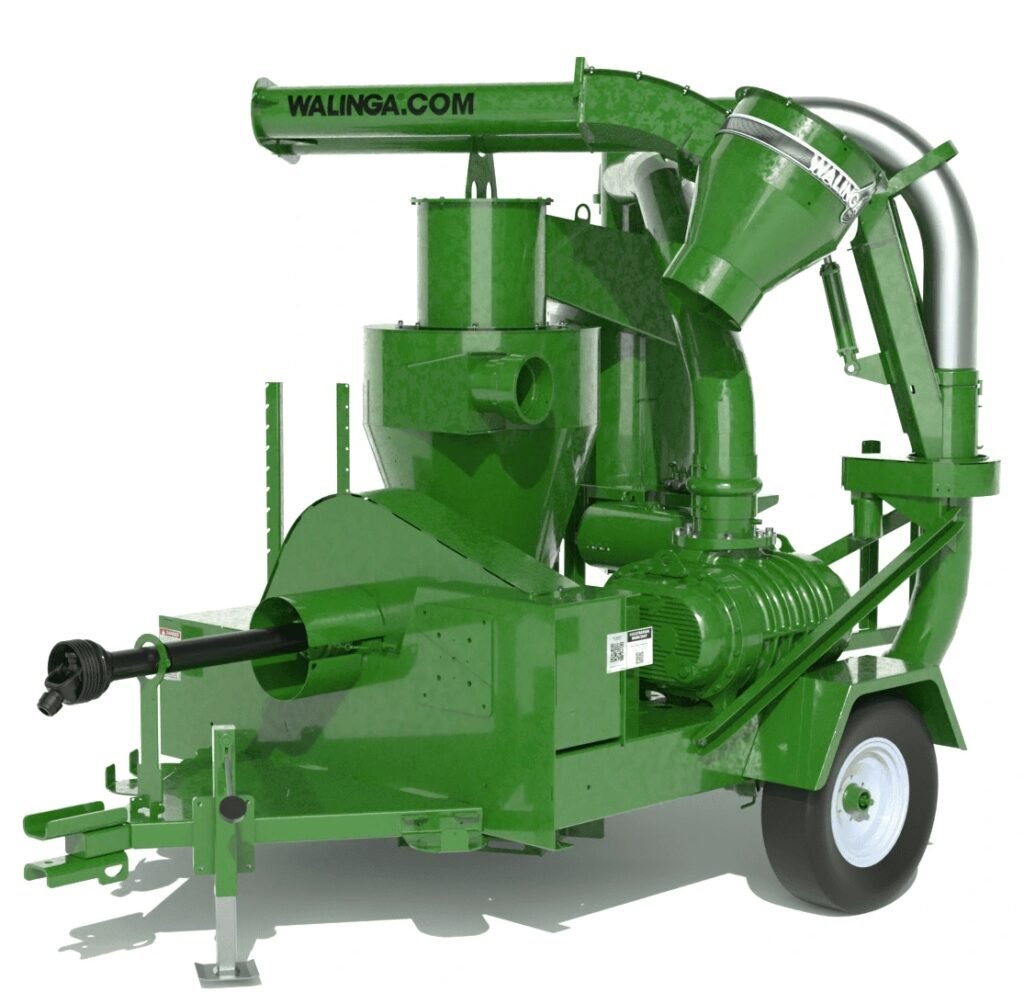
3.1 PTO-Driven Grain Vacuums (For Farm & Field Use)
PTO-driven grain vacuum systems are powered by a tractor‘s power take-off (PTO) — typically 540 rpm or 1,000 rpm. These are the most cost-effective option in terms of capital expenditure and are ideal for farms and field operations where grid electricity is unavailable.
Typical PTO models require 70 to 135+ horsepower depending on capacity. A tractor with adequate PTO output — often 90 hp or more — is necessary to overcome peak power demands and high starting torques. Capacities range from approximately 1,700 to 6,000 bushels per hour, depending on the model and grain type.
3.2 Electric & Diesel Motorized Units
For commercial facilities, grain terminals, and processing plants, electric pneumatic grain loader systems offer consistent, reliable power without the need for a tractor. Electric models range from 10 HP units handling 300–500 bushels per hour to 50 HP systems moving up to 1,900 bushels per hour.
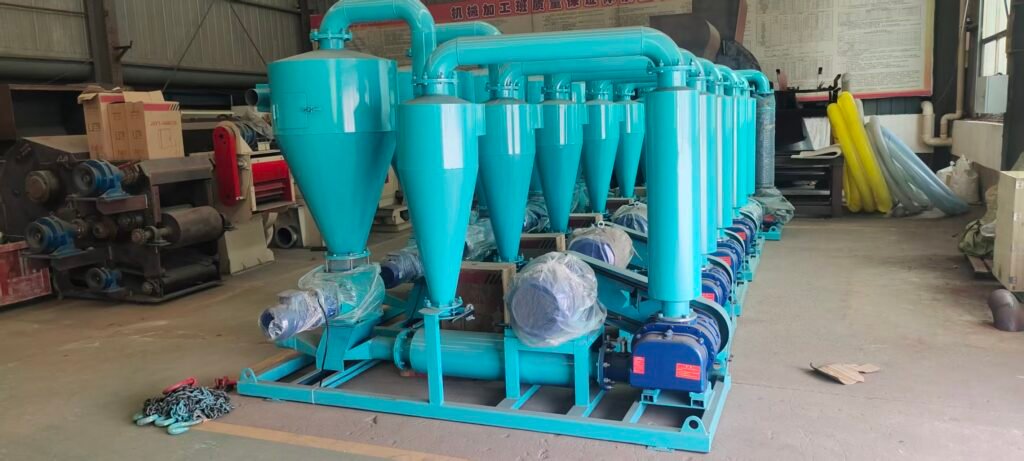
Diesel-powered mobile units provide self-contained operation for sites without electrical infrastructure or for mobile transfer services. High-capacity diesel models — such as those powered by 185 HP John Deere engines — can move up to 7,000 bushels per hour.
3.3 Portable vs. Stationary Pneumatic Grain Conveyor
Portable pneumatic grain conveyor systems are trailer-mounted or skid-mounted for easy relocation between sites. These are ideal for:
- Farms with multiple bin sites
- Custom grain transfer service providers
- Temporary storage and emergency cleanup operations
- Operations requiring seasonal flexibility
Stationary pneumatic systems are permanently installed in commercial grain elevators, feed mills, and processing plants. These fixed installations offer higher capacities, integration with automated controls, and the ability to route grain to multiple bins through a network of fixed piping.
4. Pneumatic Grain Conveyor vs. Traditional Mechanical Conveyor (Augers & Bucket Elevators)
When evaluating grain handling equipment, the choice between pneumatic and mechanical systems often comes down to specific operational requirements. The table below provides a technical comparison to guide your decision.
| Comparison Feature | Pneumatic Grain Conveyor | Mechanical Auger / Bucket Elevator |
|---|---|---|
| Routing Flexibility | High — flexible hoses and bends navigate around obstacles | Low — straight, rigid paths required |
| Grain Damage Rate | Very Low — <0.2% crackage per pass | Moderate to High — steel augers cause most damage |
| Power Consumption | Higher — less energy-efficient per ton moved | Lower — approximately 3.5–4.5× more efficient |
| Maintenance & Wear | Low moving parts in the material stream | High mechanical wear on flights, cups, bearings |
| Dust & Sanitation | Enclosed system — minimal dust | Open system — significant dust generation |
| Conveying Distance | Long distances — 100+ feet, vertical lifts up to 500 ft | Limited by auger length and elevator height |
| Operator Safety | Very good — fewer moving parts, cleaner intake | Moderate — pinch points, dust exposure |
| Capital Cost | Higher initial investment | Lower initial cost |
Key Takeaway
Choose a pneumatic grain conveyor when you need:
- Maximum routing flexibility
- Minimal grain damage for high-value commodities
- Dust-free, sanitary operation
- Long-distance or complex-path conveying
Choose a mechanical auger when:
- Capital cost is the primary constraint
- Power consumption is a critical concern
- Straight, short conveying paths are sufficient
- Grain damage is less of a concern
5. Key Factors to Consider When Selecting a Pneumatic Grain Conveyor
5.1 Capacity & Throughput Requirements (Tons per Hour / BPH)
Capacity is the most fundamental selection criterion. Pneumatic grain conveyor capacities range from small portable units handling 5 tons per hour to industrial systems exceeding 70 tons per hour.
When evaluating capacity specifications, consider:
- Bushels per hour (BPH) — common in North American agricultural applications
- Metric tons per hour (t/h) — standard for international and industrial applications
- Specific capacity — tons per horsepower-hour (ton/hp-h), typically 1.3–1.4 in wheat
Remember that stated capacities are approximate and depend on grain type, moisture content, conveying distance, piping configuration, and other variables.
5.2 Conveying Distance & Elevation Change
The relationship between distance, elevation, and required power is critical. Horizontal conveying typically requires more power than vertical conveying, though the relationship is complex and depends on system design.
Consider these factors:
- Maximum horizontal distance: Systems can convey 100–200+ feet horizontally
- Vertical lift: Grain can be lifted 30–500 feet, depending on blower capacity
- Bends and elbows: Each change in direction increases resistance and wear
- Pipe diameter: Larger diameters handle higher volumes but require more air
5.3 Power Source Availability (PTO, Electric, Diesel)
Match the power source to your site‘s infrastructure:
| Power Source | Best Application | Key Considerations |
|---|---|---|
| PTO | Farms, field operations, remote sites | Requires tractor with adequate HP; most cost-effective capital cost |
| Electric | Fixed facilities with grid power | Lowest operating cost; requires 1-phase or 3-phase power |
| Diesel | Mobile operations, sites without power | Highest fuel cost; self-contained operation |
5.4 Hose Durability & Material Considerations
Pipeline wear is a significant operational cost. Grain, particularly abrasive commodities like corn and soybeans, causes wear on hoses, elbows, and pipe walls.
For flexible hoses, specify:
- Polyurethane (PU) hoses with thick walls for superior abrasion resistance
- Antistatic properties to prevent static discharge in dry grain applications
- Food-grade materials for direct food contact applications
For rigid piping:
- Steel pipe for most applications, with abrasion-resistant materials at elbows
- Stainless steel 304/316 for food-grade and sanitary applications
- Bend radius R≥6D to minimize clogging and wear
6. Maintenance and Operational Best Practices
With 15 years in the粮食仓储机械 industry, I have seen too many operators neglect routine maintenance — leading to costly downtime, premature component failure, and reduced conveying efficiency. Here are the essential practices for maximizing the service life of your pneumatic grain conveyor.
6.1 Preventing Pipe Wear and Clogging
Clogging is the most common operational issue. To prevent blockages:
- Inspect pipe interiors regularly for material buildup
- Clean pipelines weekly for most applications; more frequently for sticky or high-moisture materials
- Maintain adequate air velocity — too low causes settling, too high increases wear
- Use surge bins or hoppers for consistent feed to prevent slugs
- Install viewing glasses to monitor grain flow and velocity
Wear is inevitable but manageable:
- Replace hoses before they rupture — a blown hose can cost hours of downtime
- Use abrasion-resistant elbows (with replaceable wear liners) at direction changes
- Monitor pipe wall thickness in high-wear areas
- Consider UHMW liners in cyclones to protect grain as it decelerates
6.2 Regular Filter Cleaning & Blower Maintenance
The blower is the heart of your pneumatic system, and the filter is its lungs. Neglect either and performance suffers dramatically.
Filter Maintenance:
- Inspect air filter elements daily
- Clean filters by blowing compressed air through them or washing with mild detergent and water
- Replace filters when cleaning no longer restores performance
- A restricted air filter reduces system capacity and can cause blower damage
Blower Protection:
- Install high-efficiency filtration (99.97%+ efficiency) to prevent abrasive dust from entering the blower
- Use pressure relief valves and vacuum relief valves with positive displacement blowers
- The BlowerGard™ filtration system, for example, can extend blower life by up to 35% by blocking approximately 99.97% of abrasive dust particles
- Budget for blower rebuilds — high-volume operators may need annual or bi-annual rebuilds with conventional systems
General Maintenance Schedule:
- Daily: Inspect air filter; check for unusual noise or vibration
- Weekly: Clean pipe interiors; inspect hoses for wear
- Monthly: Replace separator screens; lubricate bearings
- Quarterly: Lubricate blower components
- Annually: Comprehensive system inspection; replace worn components
7. Frequently Asked Questions (FAQ)
7.1 How much does a pneumatic grain conveyor cost?
Pneumatic grain conveyor price varies widely based on capacity, power source, and configuration. Entry-level portable units start around $5,000–$8,000. Mid-range PTO-driven systems range from $8,500 to $15,000+. High-capacity commercial diesel units with advanced features can exceed $28,000. Industrial stationary systems with custom engineering are quoted on a project basis.
When evaluating pneumatic grain conveyor cost, consider total cost of ownership — not just purchase price. Factor in power consumption, maintenance, downtime costs, and grain damage savings. While initial capital cost is higher than augers, the operational benefits often justify the investment for commercial operations.
7.2 Will a pneumatic grain conveyor damage fragile seeds?
The answer depends on system design and operating parameters. Independent studies show pneumatic systems cause less damage than steel-flight augers. However, fragile seeds require careful engineering. To minimize damage:
- Use lower air velocities (20 m/s is a typical baseline)
- Specify gentle conveying with appropriate bend radii
- Consider dense-phase conveying for the gentlest handling
- Avoid unnecessary passes through the system
With proper design, pneumatic conveyors handle soybeans, canola, and other oilseeds with acceptable damage levels.
7.3 What horsepower (HP) is required to run a commercial grain vacuum?
Commercial grain vacuum horsepower requirements depend on capacity, distance, and system configuration:
| Capacity | Typical HP | Application |
|---|---|---|
| 300–500 bu/hr | 10 HP | Small farms, light duty |
| 500–1,300 bu/hr | 15–30 HP | Mid-size operations |
| 3,000–4,000 bu/hr | 86–100 HP | Commercial grain vacs |
| 5,700+ bu/hr | 150+ HP | High-volume commercial |
For PTO-driven units, ensure your tractor has sufficient output — typically 70–150+ HP. Account for peak power requirements during startup, which can exceed steady-state demands.
8. Conclusion: Making the Right Investment
The decision to invest in a pneumatic grain conveyor is a strategic one. For operations requiring flexibility, gentle handling, and sanitary operation, pneumatic systems deliver unmatched value. While the initial investment and power consumption are higher than mechanical alternatives, the benefits — reduced grain damage, improved safety, lower maintenance, and the ability to reach impossible locations — often justify the premium.
When selecting your system, work with a reputable manufacturer that understands your specific application. Specify the right capacity, power source, and materials for your grains and operating conditions. And commit to a rigorous maintenance program to protect your investment for years to come.
Looking for a reliable, high-capacity pneumatic grain conveyor for your farm or commercial storage? [Contact the Karanze Engineering Team Today] or click the WhatsApp button below for instant equipment sizing and factory-direct pricing.